In 2003, sequencing the human genome cost 3 billion dollars and took 13 years. Today it takes about a day.
What is striking is that the science did not change. No one discovered anything new about DNA, and no step of the process was skipped. What changed was the speed at which that knowledge could be applied: more efficient hardware, and algorithms that run in parallel what used to run in sequence.
The output is not a "cheaper" genome either. It is the same genome, held to the same standard, now available to any hospital in under 24 hours.
Discoveries at SHIFTA follow a similar pattern. We do not move faster because we skip steps. We move faster because we stopped losing time where we used to lose it.
What this process is for
We think of discovery as a role-playing exercise. You are an alien landing on an unfamiliar planet, and you have to understand the environment, the users and the problem. That takes time, a critical eye and a method.
We built these five steps for founders and startups that needed to cut time and cost. What used to take two or three months now takes two or three weeks.
AI does not replace the process. It accelerates it and widens the field of view.
Our five steps
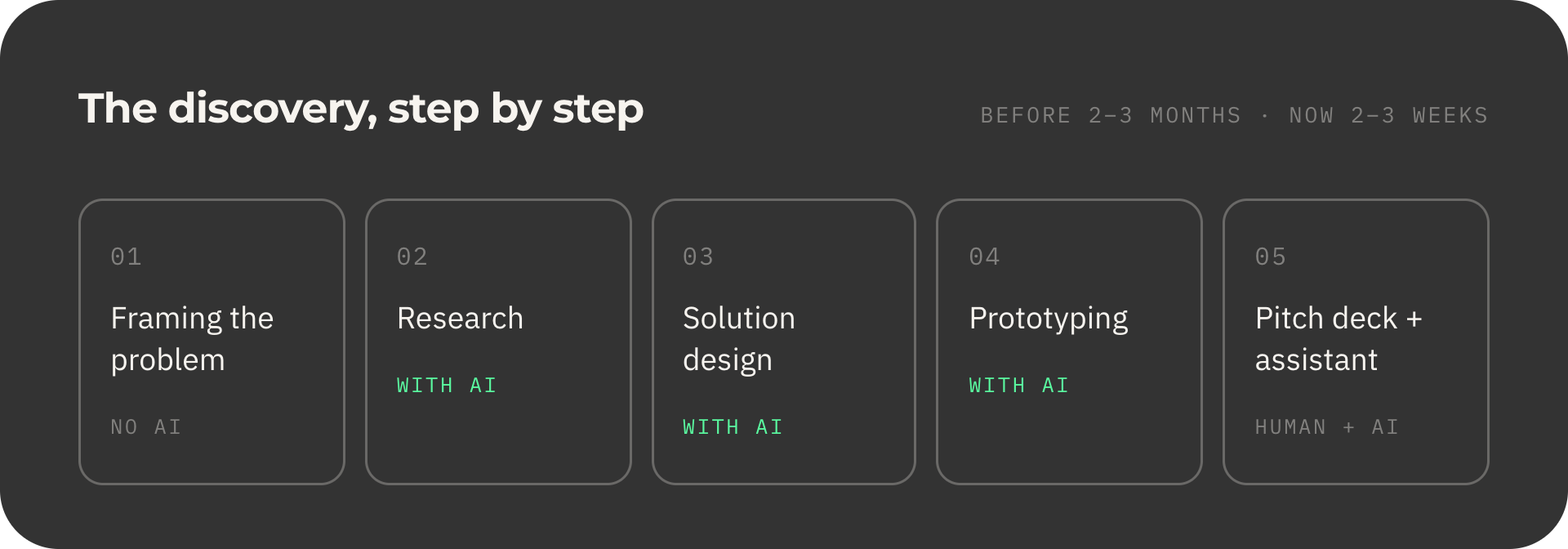
- Framing the problem
It starts when a client brings us an idea, and that idea almost always arrives dressed as a solution. Our job is to confirm that the proposed solution answers a real problem held by real people, and that the business case is worth pursuing.
It takes two hours of working session with the client to identify two things: the problem the proposed solution would solve, and who the users are that have it and stand to benefit.
We do not use AI here, and that is deliberate. What we need at this stage is not extracted, it is heard. It is the foundation for everything that follows.
- Research
With the problem and the audience defined, we research potential users and test hypotheses. This is where AI enters the process.
Interviews run in parallel
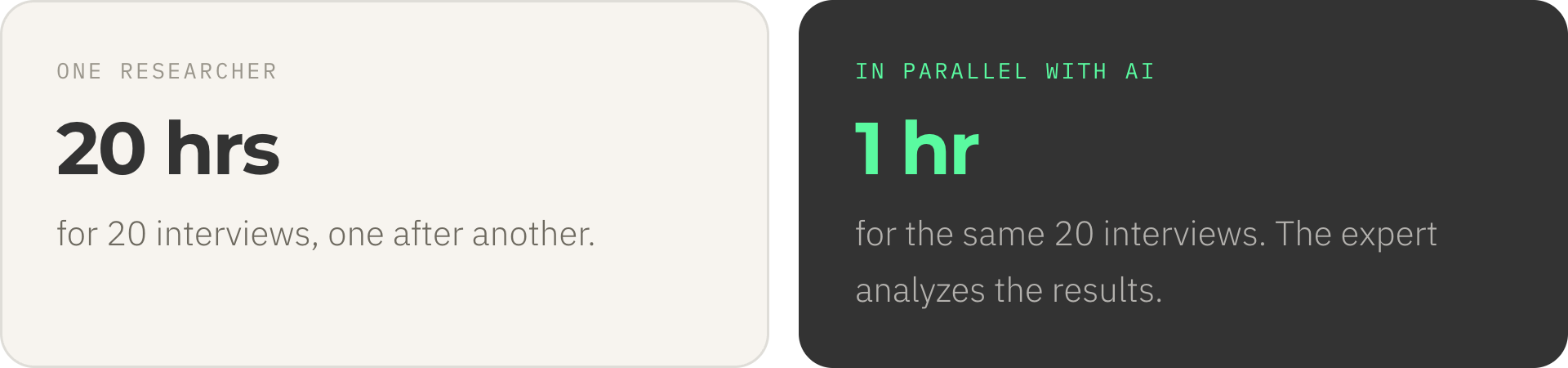
We write the interview guide with expert judgment, because the questions you ask are decisive, and use platforms such as Autentic to run them in parallel. In one hour, AI interviews 20 people; a researcher would need 20 hours. Then the expert analyzes the results.
\
Back to the genome: it did not speed up because someone read faster, but because machines processed in parallel what used to run step by step. Interviews work the same way. What does not change is who decides what to ask, and whom to ask.
Data analysis
We use Dovetail for qualitative analysis and ChatGPT for quantitative work, starting from raw databases. AI tends to surface patterns that are not obvious, and it does so much faster.
One example: for a client that wanted to launch a service for Mercado Libre sellers, the data showed the opportunity was substantial, but the users who answered the survey did not need that service. That let us reshape the solution before spending a dollar on development.
Benchmarking and proto-personas
To assess competitors, we load the analysis into ChatGPT and ask it to build the profile of the user who would choose each product. It is a solid starting point for hypothesizing which segment each one targets.
Survey visualization
When recruiting panels deliver raw data, we load it into NotebookLM and ask for the visualizations. That speeds up reading and gives us material for richer conversations with the client.
- Solution design
This is where the work gets more technical. We work with spec-driven development: we specify before we design.
The functional spec is the document where everything above lands: objective, users, scope, out of scope, flows and success criteria. Everything explored and validated takes concrete form there.
Objective - Users - Scope - Out of scope - Flows - Success criteria
Research feeds those specifications directly. On one project, the initial hypothesis was to integrate the solution with a leading CRM, on the assumption that the market was asking for it.
The research told a different story: CRM usage was widely fragmented across users and the integration could not be justified. We updated the spec before designing and saved weeks of development. And AI did not make that call; the users did.
04- Prototyping
This is where the speed is most visible. A prototype that used to take a month now takes a week. One that used to take three days now takes three hours.

We use AI across all of it, from visualizing an idea during discovery to assembling a demo for investors.
With Claude Design, the upstream work — who the users are, what problem the product solves, how it flows — translates directly into interfaces. The client sees something very close to their future product before a developer writes a single line of code.
That changes more than the calendar. It moves forward the moment the client can see, handle and challenge what they are building. The prototype arrives while there is still time, and budget, to change it.
One thing we learned: the clearer the problem is before prototyping, the better the outcome. AI translates well-defined ideas well. It translates vague ones just as fast, and the results are poor.
05- -Pitch deck + assistant
At the end we deliver a complete pitch deck made by humans — in 2026 that is worth stating — covering the value proposition and ready to present to investors or stakeholders.
We also load all the material into a NotebookLM: reports, databases, the pitch itself. The client walks away with an interactive asset: they can question the process, request summaries, generate new slides, videos, charts and even a podcast with the discovery findings.
In practice, what stays behind is an assistant that knows everything we researched and is available on demand. It is one of the highest-value pieces at handoff.
What AI enables, and what it puts at risk
AI does accelerate. It connects ideas that were previously invisible, simulates scenarios, lowers operational friction and proposes options a single person would not have reached alone.
It also carries risk. It can create an illusion of depth and flatten insights. It tends to reinforce bias from what already exists instead of finding what does not exist yet. And when it lacks context, it returns answers that sound solid without being solid.
A genome sequenced in 24 hours still needs a physician to interpret it. Speed does not replace judgment; it frees judgment for the places that actually require it. If no one with judgment reviews the results, the client pays for the error.
What we have learned so far
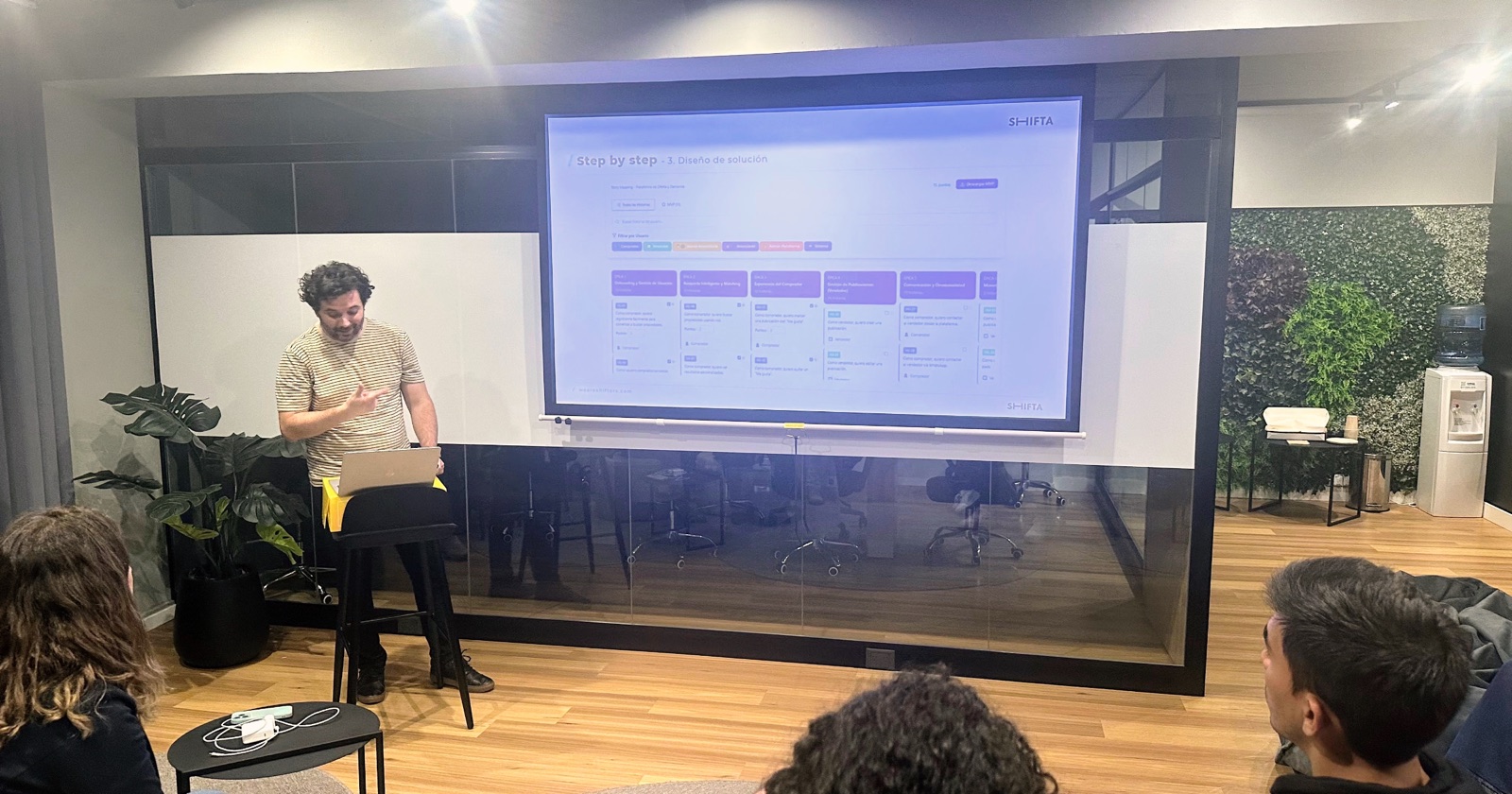
Note: This article is based on a talk by Shifta's UX team, presented at a Design Ops Chapter Latam event hosted at our offices in May 2026.